Daily Raddish · Tari News
Building on Ootle: what it can do, the SDKs, and which language to use
Ootle contracts are written in Rust; apps can be written in Rust or TypeScript. Here is what the platform can do, what it can't, which tools to use, and how to get started.
 By Sultan
Ootle is Tari's new smart-contract layer, live on mainnet since 11 November.1 If you want to build on it, three questions come first: what can it do, what tools exist, and what language do you write in? Here are the short answers, and where to go next.
What Ootle can do
Ootle runs templates, its name for smart contracts. A template is code; each time someone creates an instance of it, that instance is called a component, with its own state and its own vaults of tokens.2
- Tokens are built in. Ootle has native resources rather than token contracts: ordinary public tokens, NFTs, confidential tokens that hide balances, and stealth tokens that hide both amounts and owners. TARI, Ootle's own coin, is a stealth token.3
- Privacy you can open selectively. A token can carry a view key that reveals amounts to whoever holds it, an issuer or an auditor, without giving them the power to spend. Brale's test dollar uses exactly this.4
- Rules instead of admin code. Who may call each function is declared up front, and a contract can be made ownerless, so nobody can change its rules after launch. Since version 0.54, a deployed component cannot be switched to different code unless its creator allowed it.5
- Atomic transactions. A transaction can move several assets through several contracts at once; either everything happens or nothing does. That is what makes swaps and escrows possible.
- Fees are burned. Every fee on mainnet is currently destroyed, not paid to validators.6
What it can't do matters too. A contract cannot read a hidden (confidential) balance, so it can't, say, check that a stealth payment is large enough without the payer revealing it. And while amounts and owners can be hidden, which outputs were spent into which stays public, and a contract's own state is public.2
Under the hood: how Ootle is built
On Friday, Digital Node Capital published a good tour of Ootle's architecture:7
 Digital Node Capital@DNodeCapital · Follow
7:11 AM · Nov 20, 20268ReplyCopy linkRead on X2/ The Dual Layer
The L1 (Minotari) is PoW and built for one thing ... security. It enforces @tari's monetary policy and stays lean and rock solid, while the L2 Ootle sits on top handling the speed, running dApps, tokens and smart contracts at scale.
[…]
Only the shards a transaction actually touches need to vote on it, forming a temporary HotStuff committee to reach finality. On mainnet that's committees of 40 validators across 256 preshards ... and validators get reshuffled every epoch, so anyone trying to collude gets scattered before they can do any damage.
Here it is in plain terms.
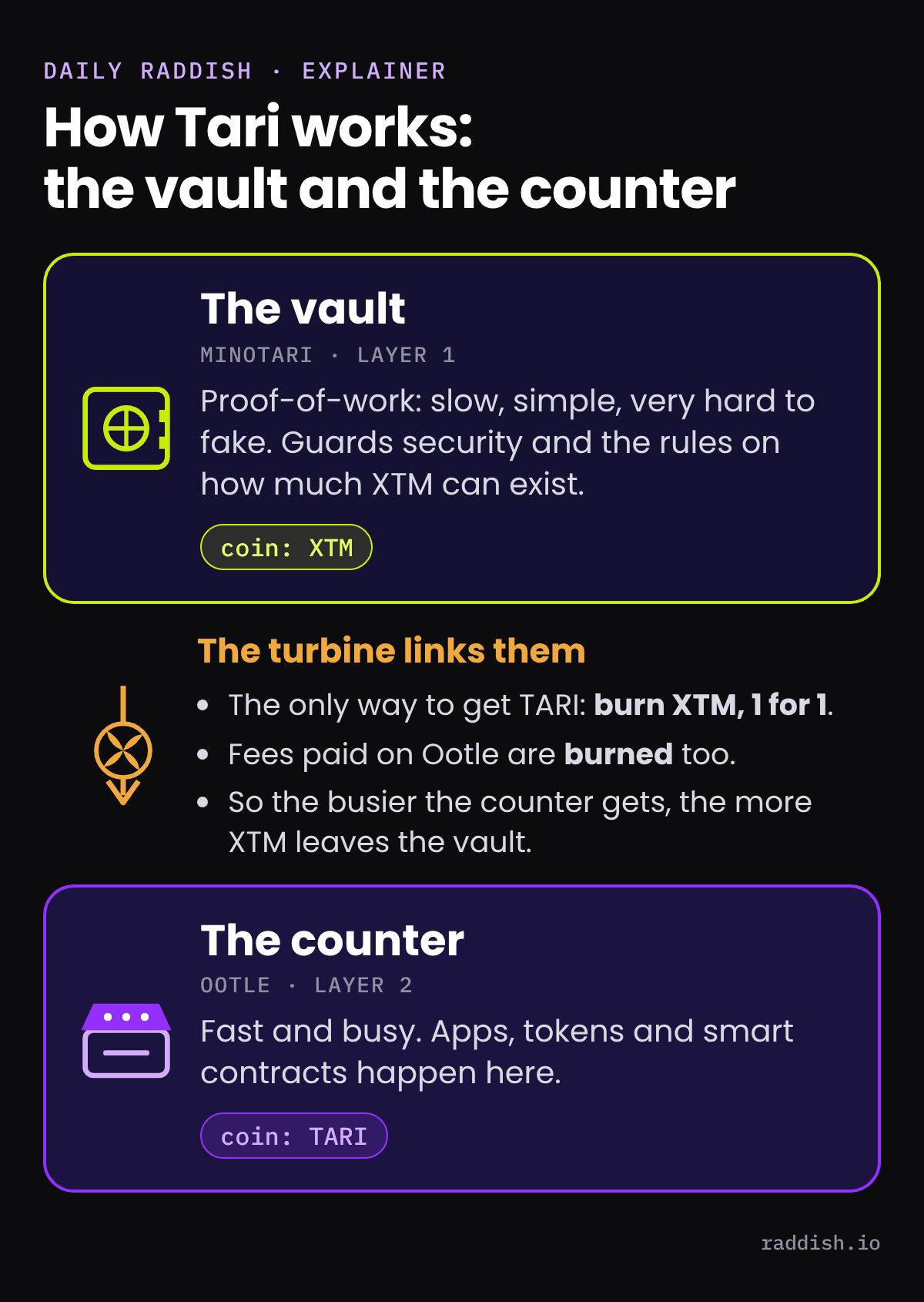
- The vault and the counter. Tari has two layers. The bottom one, Minotari, is the vault: proof-of-work, slow and simple on purpose, and very hard to fake. It guards security and the rules on how much XTM can exist. Ootle sits on top as the counter, where the fast, busy work happens: apps, tokens and smart contracts. The vault never slows down to serve customers, and the counter never weakens the vault.
- The turbine links them. The only way to get TARI, Ootle's coin, is to burn XTM, one for one, and every fee paid on Ootle is burned too.6 So the busier the counter gets, the more XTM it uses up.
- Everything is a ticket. Each piece of Ootle's state, from a balance to a contract's settings, is like a ticket that is either valid (up) or used (down), and each can be used only once. A transaction uses up some tickets and prints new ones. Before it goes through, validators put a hold on the tickets it will touch, like reserving a seat, so nothing can be spent twice. Transactions that touch different tickets don't wait for each other, so many can run at once.
- Only the right referees vote. Ootle's state is cut into 256 slices, with validators spread across them. Only the validators for the slices a transaction touches form a committee and vote on it; once more than two-thirds agree, it's final and can't be undone. The design calls for committees of 40, reshuffled every epoch, so would-be cheaters are split up before they can plot.
What's running today is smaller than the design, and smaller than DNC's "on mainnet". Ootle's mainnet indexer lists 7 validators, all covering all 256 slices, and all paying their fees to the same key. In practice that's a single operator, which matches Tari's statement that only Tari runs validators at launch, with community validators to come and no date set.89 The architecture is built to spread out; the network hasn't spread out yet.
Which language
- Contracts are written in Rust, compiled to WebAssembly, using Tari's
tari_template_liblibrary (version 0.42.0 on 19 November).10 Tari'stari-clitool scaffolds, builds and publishes them (latest release v0.36.1).11 - Apps that talk to Ootle can be Rust or TypeScript.
| You want to… | Use |
|---|---|
| Write a contract | Rust + tari_template_lib, tari-cli |
| Build an app in Rust | ootle-rs (0.37.0)10 |
| Build an app in TypeScript / JavaScript | Tari's ootle.ts packages and @tari-project/ootle-wasm (0.55.0)12, or the community @chironbuilder/ootle-sdk (0.6.1) from the Sapient wallet's developer12 |
| Connect users' wallets in a browser | the Sapient extension's window.tari provider13 |
| Run a wallet on a server | Tari's wallet daemon (JSON-RPC) |
| Just read the chain | the public indexer's REST API14 |
The tools are moving fast: most of the packages above shipped a new version this week. The TypeScript side trails Rust in places (for example, private fee payment); check the release notes before you pin a version.
How to start
- Install Rust with the
wasm32-unknown-unknowntarget, andtari-cli.2 - Scaffold a template, write it, and test it with Tari's local test tooling.
- Publish it to Esmeralda, the testnet, and try it with a wallet. Testnet funds come from burning testnet XTM; expect occasional testnet resets that wipe state.
- Read what others have built first: Ootle's code is public, and many patterns (escrows, auctions, payment channels) already exist.15
- Only then publish to mainnet, where contracts are permanent.
Our take
Ootle is unusually friendly to newcomers for a privacy chain: the concepts are few, the documentation has an index written for AI assistants,16 and Tari even publishes ready-made instructions for coding agents. The rough edges are the ones you'd expect ten days after launch: tools that change weekly, and a TypeScript kit that trails the Rust one. For agents and developers who want a quick reference, we've put one at raddish.io/agents.md.
Sources
- Tari Community, Tari Show - November 17 (YouTube). ↩
- Tari, Ootle developer documentation. ↩ a b c
- Ootle mainnet indexer,
/resources/tari: resource type stealth. ↩ - Daily Raddish, A private dollar is in testing on Ootle (19 November 2026). ↩
- Tari, tari-project/tari-ootle on GitHub (release notes, v0.54). ↩
- Ootle mainnet indexer,
/network/economics: burn rate 10,000 basis points, read 20 November 2026. ↩ a b - Digital Node Capital (@DNodeCapital), thread on Tari's architecture on X, 20 November 2026. ↩
- Ootle mainnet indexer,
/validatorsand/network/stats, read 20 November 2026: 7 validators, one shard group spanning all 256 preshards, one fee-claim key. ↩ - Tari Community, Tari Show - November 17, at about 7:56: validators are a trusted set for now; community validators have no date. ↩
- crates.io,
tari_template_lib0.42.0 andootle-rs0.37.0, both updated 19 November 2026; read 21 November 2026. ↩ a b - Tari, tari-project/tari-cli on GitHub: latest tag v0.36.1, read 21 November 2026. ↩
- npm,
@tari-project/ootle-wasm0.55.0 (19 November 2026) and@chironbuilder/ootle-sdk0.6.1 (20 November 2026); read 21 November 2026. ↩ a b - chironbuilds/tari-wallet on GitHub (Sapient; mainnet support since v0.9.0). ↩
- Ootle mainnet indexer, API description. ↩
- Daily Raddish, Nine days in, here is what people are building on Ootle. ↩
- Tari, Ootle docs index for AI tools. ↩