Daily Raddish · Tari News
Sapient wallet review: keys, sign-ins and what builders should know
Most Ootle apps, raddish included, ask you to connect a wallet called Sapient. It is built by Erebus Labs, an independent builder, not by Tari, and it has kept pace with every Ootle upgrade since launch. We read its source and its releases. It keeps your keys sensibly and asks before it signs. The next steps that would help it most are an outside audit and a Play Store listing, and the community can help with both.
 By Sultan
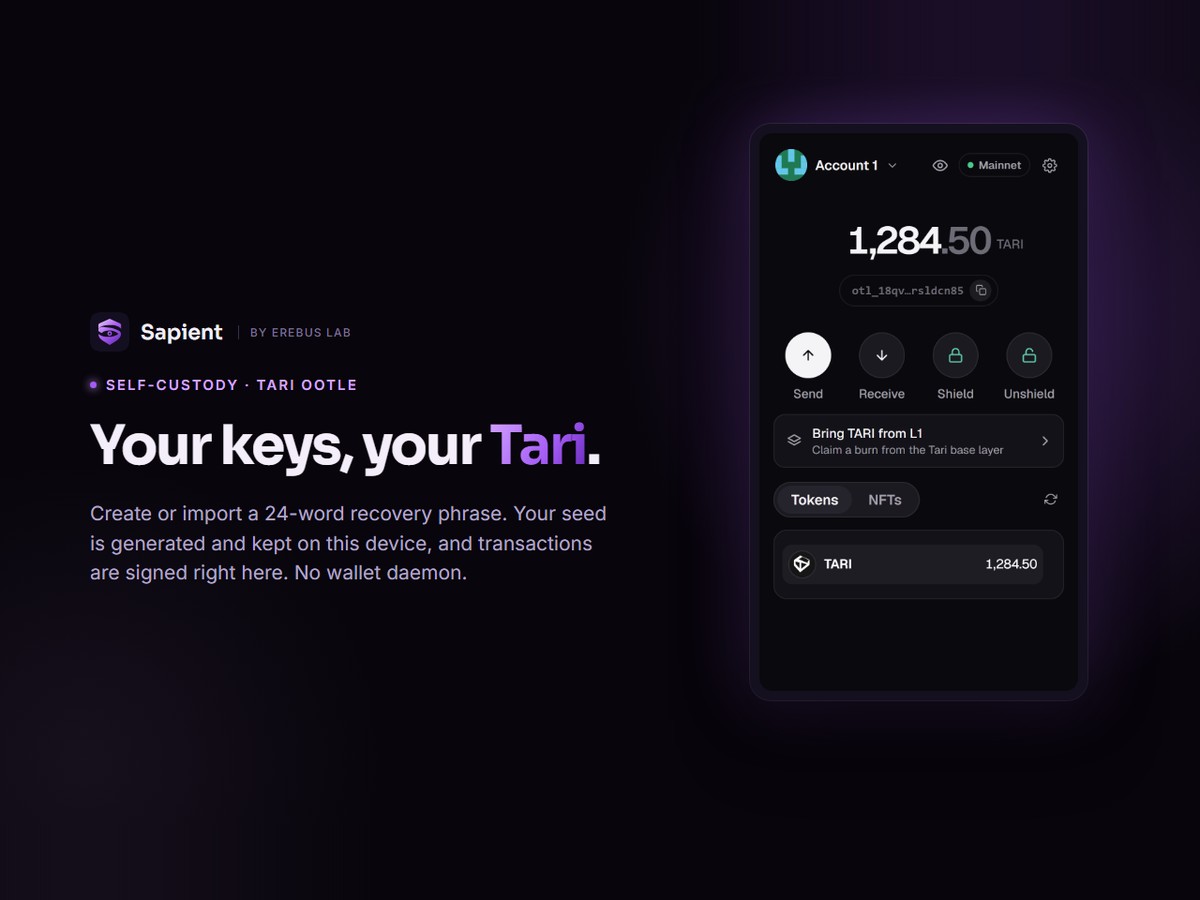
If you have tried an app on Ootle, Tari's new private smart-contract network, you have probably been asked to connect Sapient. It is a browser extension for Chrome and an app for Android that holds your TARI and signs what you approve, the way MetaMask does for Ethereum. Lobby, the community's directory of Ootle projects, lists it among the live apps.1
A lot of Ootle now runs through it, so we wanted to understand it properly. We read its code and its release history. We came away impressed.
Explain it simply: what does a wallet extension do? It keeps the secret key that controls your coins, locked on your own device. When a website wants to move your coins or prove who you are, it asks the extension, and the extension shows you a pop-up. Nothing happens unless you click approve. The website never sees your key. A good wallet's job is to keep the key safe, show you clearly what you are approving, and refuse everything else.
Who makes it
Sapient is made by Erebus Labs, an independent builder. Its website says it is "not affiliated with the Tari Project".2 The code is open source under the MIT licence, so anyone can read it, check it, or help improve it.3
On 30 September, six weeks before Ootle's mainnet went live, Erebus Labs introduced Sapient on X:4
 Erebus Labs@Erebus_Lab · Follow
7:13 AM · Sep 30, 20266ReplyCopy linkRead 2 repliesMeet Sapient 🧠 a wallet extension built for Ootle. Manage your assets and interact with Ootle apps right from your browser. Here's the pitch 👇
It has kept pace with Ootle
Ootle went live on 11 November and changed fast: six upgrades in its first nine days, three of them breaking.5 That is hard on anyone building on it. Sapient kept up every time.
- Mainnet since 0.9.0, on 8 November, three days before launch. Wallets that never picked a network were moved to mainnet automatically.6
- Version 0.11.0, on 20 November, supports Ootle 0.55's new way of signing transactions, which changed what a wallet has to sign.7 It shipped the same day as Ootle's own release, built on parts of Ootle's toolkit that were still being finished.8
- Android: four releases in three days, 0.10.1 on 18 November to 0.11.0 on 20 November.9 New in that run: sending and receiving NFTs, fingerprint unlock, and WalletConnect, which lets Android apps and websites ask the wallet to sign.7
- iPhone: a Face ID version is in the works on a separate branch.7
How it keeps your keys
From the code, read at version 0.9.7 and checked again at 0.11.0:67
- Your recovery phrase is encrypted with your password (AES-256-GCM, with the key stretched 600,000 times, which meets current industry guidance) and stored only on your device. When you create a wallet, it makes you re-type three random words from your phrase, so you can't skip writing it down.2
- While unlocked, the key is held in memory that web pages can't reach. It locks itself after 15 minutes by default. You can set it to "Never"; we'd leave it on.
- No tracking. We found no analytics code, and there is no Sapient server: the wallet talks only to the Ootle network and to sites you approve.710
These are the right choices, and they are not always the ones new wallets make.
What websites can and can't do
- Connecting needs your approval, one site at a time and for one account. Seeing your private balances needs a second, separate approval.6
- It won't sign just anything. A site can't hand Sapient arbitrary data to sign; it can only ask for payments, which you approve, or a sign-in proof. Sign-in proofs are wrapped in their own label, so one can never be passed off as a payment.611
- It guards against spam: it caps pop-ups at three per site, so a page can't flood you.6
- Worth knowing: Sapient is visible to every web page you open, so any page can tell you have it installed, and a connected site can run test simulations, such as live price quotes, without a pop-up. Both are documented, and neither moves money.711
A tip for builders: sign-in
When a site asks you to "prove you own this address", Sapient signs a short message the site supplies. It signs exactly what the site wrote, and it does not add the site's own web address on top.76
So each site should put its own domain in the sign-in message, as Ethereum's "Sign-In with Ethereum" standard does, and check it when the signature comes back. That stops a signature made for one site from being reused on another. raddish does this.12 Every Ootle app that uses Sapient for sign-in should, too. On Android, Sapient already adds a check of its own: it runs each WalletConnect site through a verification service and flags known scam sites. Apps that register their domain show as "✓ Verified" on every approval; apps that don't show as unverified, so builders should register.711
Where it goes next
Sapient is young, and it is honest about it. A few things would help it grow, and most of them are things the community can help with.
- An outside audit. Sapient has published two rounds of self-review, done with different tools, with every finding listed by file and line; they found and fixed real bugs, including an auto-lock bypass.2 The review is upfront that it is "not a substitute for a paid external audit" before real money at scale.13 An independent audit is the natural next step.
- A Play Store listing. Today the Android app comes as an APK file from GitHub. Each release lists its SHA-256 checksum and signing certificate fingerprint, so a careful user can check the file is genuine.9
- More users. The Chrome Web Store showed version 0.11.0, 89 users and two five-star ratings when we checked on 23 November.14 Early days.
- More hands. A small, independent team signs every release. That is how most good wallets start. Contributions, code review and testing all help.
For builders: where to start
Building an Ootle app that connects to Sapient? These are the best starting points. (New to Ootle itself? Start with our guide to building on Ootle: its SDKs and languages.) Sapient and the Tari Universe web wallet answer the same calls, so one integration covers both.11
- The dApp integration guide: connecting, methods, Android, sign-in proofs, errors and common pitfalls, on one page.
- A working example: a real app that uses every piece of the guide, to copy from.
- For AI coding agents: a ready-made skill file, a short llms.txt summary, the full reference and TypeScript types.
- Going deeper: the wallet's provider API reference and architecture notes, and the shared TypeScript SDK (npm
@chironbuilder/ootle-sdk).
Five questions, answered from the code
| Question | Answer |
|---|---|
| Does any site see my key? | No. Keys stay in the extension's background, encrypted at rest. |
| Can a site move money without me? | No. Payments need a pop-up approval. |
| Is sign-in safe? | Yes, when the site names itself in the message, as good sites do. |
| Has anyone independent audited it? | Not yet. Its security reviews so far are self-reviews. |
| Is the Android app official? | It's Erebus Labs' own build, from GitHub. Check the checksum. |
Our take
Sapient is careful, open and fast-moving work, and Ootle is lucky to have it. In its first ten days on mainnet it has done what a wallet must: keep keys local, ask before it signs, and keep up with a network that changed under it six times.
It is doing that early, in a young ecosystem. Twelve days after launch, Ootle's TARI isn't on any exchange, and wrapped TARI, which Tari says is coming to Base in "weeks, not months", hasn't launched yet.15 TARI comes into Ootle one way, by burning XTM, so for now it can only be swapped inside Ootle. Apps such as sooon.fun still use wallets built into their own sites;16 the more of them that connect to Sapient, the easier Ootle gets to use. Erebus Labs also runs Veil, an Ootle block explorer, so its work already covers two of the basics a new network needs.17
So much of Ootle now leans on it that its success is everyone's. Sapient has no business model by design: no fees, no premium tier, no data sold. It runs on the goodwill of people who want Ootle to exist, and its site takes donations.2 The best thing the ecosystem could do is fund an independent audit, through Tari's grants or the community, and for every app to name its own domain in sign-in messages. We'd be glad to see both.
If you use it today: install the Chrome version from the Web Store link on its official site,2 check the checksum if you take the Android app, keep the auto-lock on, and follow Erebus Labs' own advice: "Start with small amounts: Sapient is new software."2 This is not financial advice.
Sources
- Lobby, lobby.tari.com, the community-run directory of Ootle projects, read 22 November 2026 (Sapient listed among live apps). ↩
- Sapient, sapient.tari.mw, read in full 23 November 2026: "Live on Ootle mainnet · v0.11", credited to Erebus Labs, "not affiliated with the Tari Project"; the Security and Support sections. Its Chrome link is the Chrome Web Store listing. ↩ a b c d e f
- Erebus Labs, tari-wallet on GitHub (MIT licence). ↩
- Erebus Labs (@Erebus_Lab), introducing Sapient on X, 30 September 2026. ↩
- Tari, tari-ootle releases on GitHub: v0.53.2 (11 November) to v0.55.0 (20 November); breaking changes in v0.53.4, v0.54.0 and v0.55.0, as recorded in each release's notes. ↩
- Erebus Labs, tari-wallet at commit
81ba6a5(version 0.9.7), and its Ootle SDK'ssrc/ootleNetwork.ts, read 19 November 2026. ↩ a b c d e f - Erebus Labs, tari-wallet at commit
b50199d("0.11.0: Ootle 0.55 (transaction schema V2)", 20 November 2026), read 22 November 2026. ↩ a b c d e f g h - Erebus Labs, ootle-sdk-ts commits
6acf183,ac8d9f1andb3570d8(0.6.2, 22 November); npm versions 0.5.2–0.6.2 were published from itsootle-0.55-v2branch, not yet merged, with a vendored, patchedootle-wasm. Read 23 November 2026. ↩ - Erebus Labs, tari-wallet releases on GitHub: android-v0.10.1 (18 November), v0.10.2 and v0.10.3 (19 November), v0.11.0 (20 November 2026), each with SHA-256 checksums and the signing-certificate fingerprint. Still the latest release on 23 November. ↩ a b
- Sapient, Privacy Policy (last updated September 2026), read 23 November 2026. ↩
- dApp integration guide for Tari Ootle wallets, linked as "Docs" from Sapient's site, read 23 November 2026: "Ownership proofs", "Quotes are free" and "Sapient for Android". ↩ a b c d
- raddish.io's sign-in challenge names the domain
raddish.io, in the style of Sign-In with Ethereum (EIP-4361). ↩ - Erebus Labs, SECURITY_AUDIT.md (first dated 25 July 2026, with addenda through 15 November 2026), which describes itself as a self-review. ↩
- Chrome Web Store, Tari Ootle Wallet, read 22 and 23 November 2026: version 0.11.0, updated 20 November, 89 users, two ratings. ↩
- Tari Community, Tari Show - November 17 (YouTube): the Base bridge at 17:07–24:08. ↩
- sooon.fun site code, read 23 November 2026: it signs with its own built-in wallet; no
window.taricalls found. ↩ - Erebus Labs, Veil, a Tari Ootle explorer (code, first published 18 August 2026). Tari's own
ootle-explorerrepository is empty. Read 23 November 2026. ↩